
Renewable Energy & Carbon Glossary
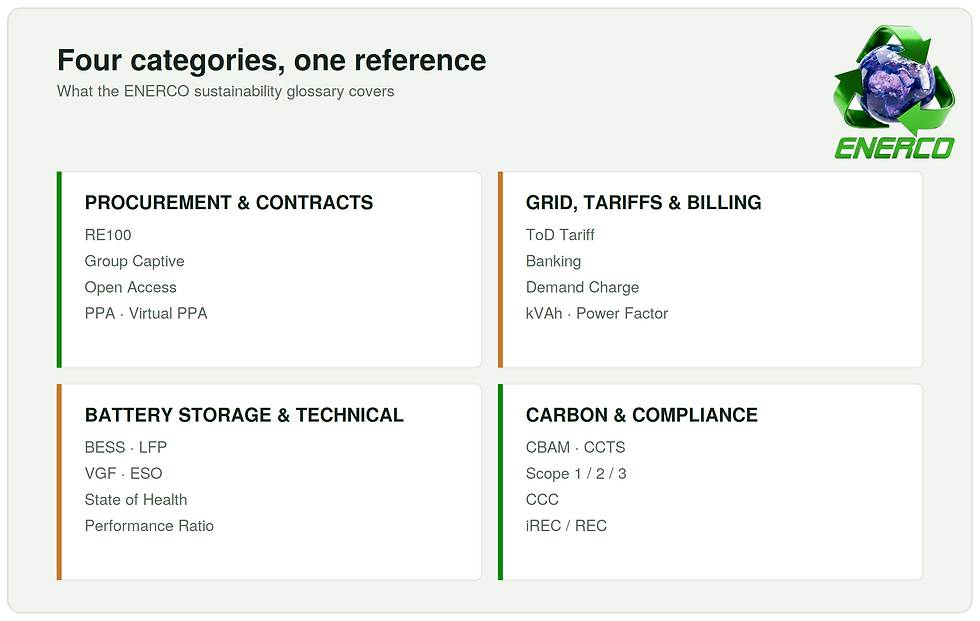
Every sector develops its own shorthand, and renewable procurement, battery storage, and carbon compliance have developed theirs faster than most people can keep up with. This page is a working reference, not a sales pitch: plain-language definitions for the terms that come up constantly in C&I energy decisions, grouped by where they actually matter. Where we've written a full guide on a topic, it's linked, so you can go deeper the moment a one-line definition isn't enough.
Renewable Procurement & Contracts
RE100 — A global corporate commitment to source 100% of electricity from renewable sources, usually on a stated timeline. For large Indian exporters it's increasingly a buyer requirement, not just a sustainability goal. See the full [RE100 Blueprint] for how Indian CXOs are actually building the roadmap.
Group Captive — A power project structure where consumers collectively hold at least 26% equity and consume at least 51% of the output, qualifying it as a Captive Generating Plant under the Electricity Rules, 2005. This exempts the project from cross-subsidy surcharge and additional surcharge. Covered in depth in the [RE100 Blueprint].
Open Access — Buying power directly from a third-party generator via a PPA and paying to move it across the grid, without taking equity in the project. Faster to set up than group captive, but carries the surcharges that captive structures avoid.
CAPEX (solar or BESS) — The consumer owns the asset outright. Best long-run economics, full performance risk sits with the owner.
OPEX / RESCO — A zero-capex model where a third party owns and operates the asset and the consumer pays only for the power or service delivered. Weaker unit economics than CAPEX, but no balance sheet exposure.
PPA (Power Purchase Agreement) — The contract governing price, tenure, and terms for buying power from a specific generating asset, typically running 15 to 25 years for large C&I projects.
Virtual PPA — A financial contract for difference layered on top of a renewable project, without physical delivery of electricity to the buyer's site. Lets a buyer claim renewable attributes from a project anywhere in the country rather than only where the grid connection allows. We're covering this in full in an upcoming guide.

Grid, Tariffs & Billing
ToD (Time-of-Day) Tariff — A tariff structure that charges different per-unit rates depending on the time of day power is drawn, designed to push consumption toward off-peak hours.
Banking (Solar Banking) — Feeding surplus solar generation back to the grid and drawing an equivalent amount later, in effect using the grid as storage. In Maharashtra, MERC's Order 75 of 2025 restricted this to same-slot banking, closing the cross-slot arbitrage that used to make solar-only projects attractive for round-the-clock loads. More on what this means in practice in the [BESS guide].
Cross-Subsidy Surcharge (CSS) — A charge paid by open access consumers to offset the subsidy the distribution utility provides to other consumer categories. Group captive structures are exempt from it.
Wheeling Charges — The fee paid to use the grid's transmission and distribution infrastructure to move power from a generator to a consumer at a different location.

Demand Charge — The portion of an industrial electricity bill billed against peak kW drawn during the billing period, not total units consumed. In many Indian C&I tariff categories this is 30 to 70% of the total bill, and it's set by just a few minutes of peak draw.
kVAh Billing / Power Factor — A billing structure based on apparent power (combining active and reactive power) rather than active power alone. A poor power factor increases the effective bill even if actual energy consumption hasn't changed, which is why power factor correction is now a real line item to manage, not an afterthought.
Battery Storage & Technical
BESS (Battery Energy Storage System) — A battery installation that stores electricity for later use, typically deployed for peak shaving, time-of-day arbitrage, or improving solar self-consumption. Full economics and technology breakdown in the [BESS guide].
LFP (Lithium Iron Phosphate) — The dominant battery chemistry in Indian grid-scale and C&I storage tenders, valued for safety and cycle life over energy density.
VGF (Viability Gap Funding) — Government subsidy support that covers part of a project's capital cost to make the tariff bankable. India's current BESS VGF scheme can cover up to 40% of capex.
ESO (Energy Storage Obligation) — A regulatory requirement that generators and distribution utilities source a rising share of supply from storage-backed contracts, climbing from 1% in FY 2023–24 to 4% by FY 2029–30.
State of Health (SoH) — A measure of a battery's remaining capacity relative to when it was new. A common contract benchmark is 80% SoH retained at year 10, and it's worth writing into any BESS contract as a guarantee, not an assumption.
Performance Ratio (PR) — The ratio of a solar plant's actual energy output to its theoretical output under ideal conditions. It's the single most useful number for diagnosing why a plant is underperforming, and we'll be covering common causes in a dedicated guide shortly.
Carbon & Compliance
CBAM (Carbon Border Adjustment Mechanism) — The EU's mechanism for pricing the embedded carbon in imported goods like steel, cement, and aluminium, so that imported and EU-made goods face a comparable carbon cost. Full breakdown, including the current certificate timeline, in the [CBAM guide].
Embedded Emissions — The total carbon footprint built into a product across its production, including the Scope 2 emissions from the electricity used to make it. This is the number CBAM certificates are calculated against.
CCTS (Carbon Credit Trading Scheme) — India's domestic compliance carbon market, replacing the earlier PAT scheme, covering nine energy-intensive sectors with intensity-based emissions targets. Full mechanics, sector coverage, and 2026 timeline in the [CCTS guide].
CCC (Carbon Credit Certificate) — The tradable unit under CCTS. Entities that beat their emissions intensity target earn CCCs to sell; entities that miss it must buy and surrender CCCs to cover the shortfall.
Scope 1, 2, and 3 Emissions — The standard categories for carbon accounting: Scope 1 is direct emissions from owned operations, Scope 2 is emissions from purchased electricity and heat, and Scope 3 covers everything else in the value chain, from suppliers to product use. Most renewable procurement decisions move the Scope 2 number directly.

iREC / REC — Certificates that represent proof that one unit of electricity was generated from a renewable source, tradable separately from the underlying power itself. Distinct from a carbon credit, which represents an emissions reduction rather than a generation attribute. We're covering the practical difference, and when each one actually matters for a buyer, in a dedicated guide shortly.
Where to Start
If a term on this page connects to a decision you're actually weighing, procurement route, storage sizing, CBAM exposure, CCTS compliance, the full guides linked above go deeper than a glossary entry can. If you'd rather talk it through directly, that's what we do.
Want to model what any of this means for your specific site?
[Talk to our team → +91 20 35904874 / Info@EnercoEnergySolutions.com / Enerco@Ymail.com]



Comments