
RE100 Blueprint: How Indian C&I Companies Are Actually Getting to 100% Renewable Power
Updated: Sep 7
RE100 used to be a slide in a sustainability deck. It isn't anymore. I've sat in enough board reviews over the past two years to watch this shift happen in real time: a CFO who once treated the renewable energy target as a CSR line item now wants to know exactly which MW gets contracted in which quarter, and why.
Three things pushed it there.

Buyers are asking. Global brands are pushing Scope 3 targets down their Indian supply chain, and a "we're working on it" answer doesn't clear a vendor audit anymore.
The economics flipped. Grid tariffs for HT industrial consumers in Maharashtra routinely run ₹8–10/kWh once you load in demand charges and cross-subsidy surcharge. A well-structured captive or open access solar project lands power at roughly half that, for 25 years, with the price locked at signing.
Carbon has a price at the border. CBAM and its successors mean that a tonne of embedded carbon in an export shipment is no longer a footnote, it's a line item on the invoice. For steel, cement, aluminium and chemicals exporters, an unclean electricity mix is now a direct cost, not just a reputational one.
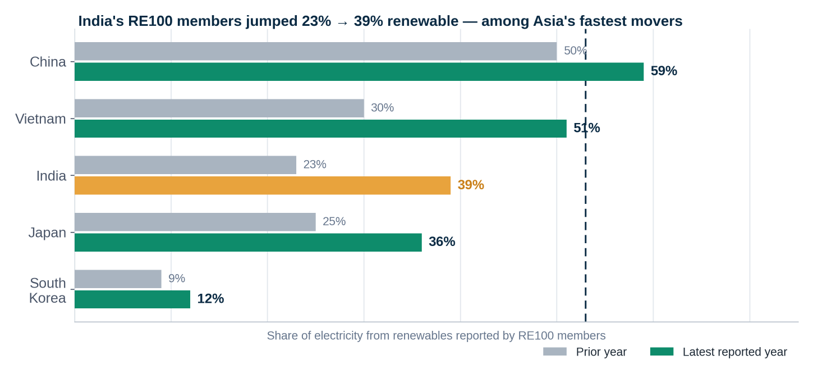
India's own numbers back the shift: the country's installed renewable capacity crossed roughly 288 GW by mid-2026, up from under 80 GW a decade ago, and solar alone now accounts for more than half of it. The infrastructure to build a serious RE100 pathway exists. What most companies are missing isn't access to renewable power. It's a clear-eyed view of which procurement route actually fits their site, their load, and their balance sheet.
There are three real routes to 100% renewable electricity for a large Indian C&I consumer. Here's how each one actually works, not the marketing version.
Route 1: Group Captive
This is the workhorse structure for mid-to-large industrial consumers, and it just got a meaningful regulatory update.
Under Rule 3 of the Electricity Rules, 2005, a power plant qualifies as a Captive Generating Plant when its captive users collectively hold at least 26% ownership and consume at least 51% of the electricity it generates annually. Get that structure right and you're exempt from cross-subsidy surcharge and additional surcharge, the two charges that erode the economics of a simple open access deal. That's the difference between landed power in the ₹4–5/kWh range and grid power at double that.
The Electricity (Amendment) Rules, 2026, which came into force in stages starting March 13, 2026, changed how that 26/51 test gets applied to multi-company group structures. Compliance is now assessed at the collective level across the association of captive users rather than user by user, and a captive user's group entities (subsidiaries, holding company) are treated as one entity for the purpose of the calculation. In plain terms: it's now easier to build a group captive project across a corporate group's multiple plants and entities without one site's consumption shortfall disqualifying the whole structure. If your group has been sitting on a captive project because the old proportionality rules made the numbers too fragile, it's worth revisiting the model now.

Group captive works best for consumers with predictable, sizeable HT loads (typically monthly bills above ₹40 lakh) and the balance sheet appetite to take an equity stake in an SPV. It's a 12–18 month build from feasibility to commissioning, and it rewards getting the legal and financial structuring right up front far more than it punishes a slightly higher upfront cost.
Route 2: Open Access (Third-Party PPA)
Open access is the faster, lighter-weight option. You sign a power purchase agreement with a developer's project, pay wheeling and transmission charges to move that power across the grid to your site, and you don't need to hold equity in anything.
The trade-off is that you carry cross-subsidy surcharge and additional surcharge, which narrows the savings compared to group captive, and those charges are set by the state regulator and can move. In Maharashtra specifically, banking rules matter as much as the surcharge does. Under MERC's current same-slot banking framework, solar generation that isn't consumed in the same time slot it's produced doesn't roll over into a different, more valuable slot; in the C-Zone in particular, unbanked surplus in a low-value slot can lapse at effectively zero value rather than being credited at a blended rate. That single detail changes the entire financial model for a solar-only open access project versus a wind-solar hybrid one, because hybrid generation profiles bank far more cleanly against an industrial load curve.
Open access suits consumers who want renewable power now, don't want capital tied up in an SPV, and are willing to actively manage (or have someone actively manage) their banking and scheduling position rather than treat it as a set-and-forget contract.
Route 3: Direct High-Capacity PPA
For very large single-site consumers, typically 10 MW and above at one location, a direct PPA with a large-scale offsite or onsite generator becomes viable on its own, without pooling with other consumers. This is the route most large steel, cement, and chemical plants with genuinely enormous, stable loads end up on, often paired with a wind-solar hybrid or firm-and-dispatchable structure to smooth out the generation profile against a 24x7 process load.
The commercial terms here are closer to an infrastructure contract than a retail power deal: 15–25 year tenure, detailed curtailment and change-in-law clauses, and real negotiating leverage on both sides given the contract size. This is also where PPA tenure mismatches quietly erode value. A wind asset built on an older turbine platform, for instance, may only support a 10–12 year PPA against the 25-year tenure a newer platform or a solar asset can offer, which changes the entire lifecycle economics even if the headline tariff looks identical on day one.
Building Your Roadmap
Whichever route fits, the sequence that actually works is the same:
Baseline your consumption honestly. Load profile, ToD (time-of-day) distribution, and seasonal variation matter more than annual kWh totals. A flat industrial load banks very differently against solar than a load with an evening peak.
Pick your state and zone with the regulation in mind, not just the tariff. Two states with similar solar irradiation can produce very different project economics once banking rules, surcharge structures, and open access charges are factored in.
Model the financing structure before the technology. Group captive, OPEX/RESCO, and direct CAPEX carry very different balance sheet and cash flow implications; get finance and the board aligned on the structure before you shortlist developers.
Structure the PPA to match your asset's real life, not its marketing life. Tenure, degradation guarantees, and curtailment terms deserve as much scrutiny as the headline tariff.
Phase it. Very few companies go from 0% to 100% renewable in one contract. A phased approach, often rooftop or captive first, open access second, lets you learn the regulatory mechanics on a smaller commitment before scaling.
Where This Usually Goes Wrong
In our own project evaluations, the same handful of mistakes show up repeatedly: developers get shortlisted on tariff alone without checking asset technology or PPA tenure; banking and scheduling get treated as an afterthought until the first settlement bill arrives; and equity structuring for group captive gets finalised before anyone checks it against the current consumption thresholds. Every one of these is fixable if it's caught during the feasibility stage. Almost none of them are fixable cheaply once the project is commissioned.
Where to Start
If you're evaluating a path to 100% renewable electricity for your facility, the right starting point is a proper feasibility study, not a developer's proposal. Enerco has run this exercise as an independent advisor for C&I consumers across India and the Middle East since 2009: no hardware sales, no EPC work, no vendor commissions, so the recommendation is built around your load and your balance sheet, not around what someone else is trying to sell you.
Want the full RE100 Blueprint toolkit? Download the PDF: https://www.enercoenergysolutions.com/re100-blueprint-corporate-renewable-energy-strategy



Comments